
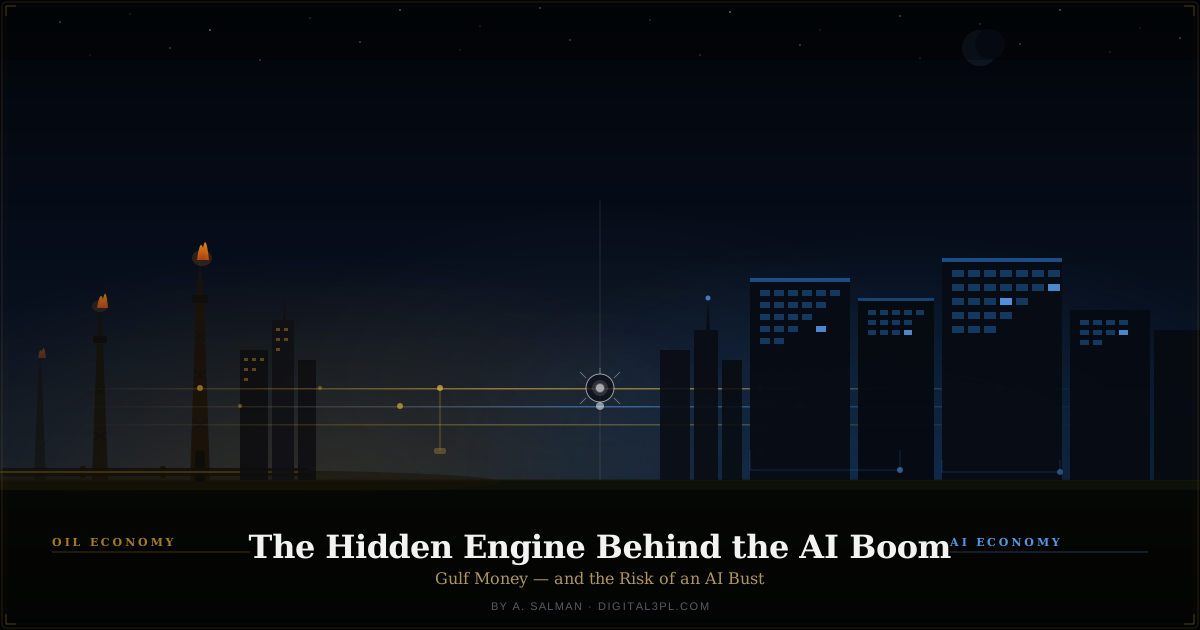
The Hidden Engine Behind the AI Boom:
Gulf Money — and the Risk of a Bust
The AI revolution runs on capital as much as code. And much of that capital flows from oil-rich nations racing to reinvent themselves before the oil era ends.
The modern AI race is not only a competition of algorithms. It is a competition of funding, energy, and infrastructure — and much of that funding comes from economies built on oil, not code.
The artificial intelligence boom is often presented as a purely technological revolution driven by Silicon Valley, research labs, and brilliant engineers. But anyone who looks deeper quickly realizes that technology alone does not build an industry. Behind every boom there is capital — and behind the current AI boom there is an enormous flow of money from the Gulf countries: Dubai, Saudi Arabia, Qatar, and Abu Dhabi.
These oil-rich states, through their sovereign wealth funds and government-backed companies, have become some of the largest financiers of the global AI infrastructure race. And that creates a dangerous dependency that very few people are talking about openly.
If the Gulf economies weaken, the AI boom could slow — or collapse.
Section IThe AI Boom Is Built on Capital, Not Just Code
Artificial intelligence today requires something previous software revolutions did not need at this scale: massive physical infrastructure. This is not a garage startup environment. This is heavy industry — and heavy industry needs deep pockets.
- Data centers that cost billions of dollars to build and operate
- Advanced AI chips priced at tens of thousands of dollars each
- Gigawatts of continuous, reliable electricity
- Long-term financing with very high risk tolerance
That is where the Gulf entered the picture. Sovereign wealth funds from Saudi Arabia, the UAE, and Qatar control trillions accumulated from oil exports — now being redirected into AI, cloud computing, and digital infrastructure.
Section IIWhy the Gulf Became the AI Industry’s Banker
The involvement of Gulf countries in AI is not accidental. It is deeply strategic. These countries have three things the AI industry desperately needs.
Western investors demand fast returns. Sovereign wealth funds invest for decades — ideal backers for billion-dollar infrastructure with long payoff horizons.
AI data centers consume enormous electricity. Gulf nations have abundant oil, gas, and solar — plus vast land for large-scale computing hubs.
These economies know oil won’t sustain them forever. AI, robotics, and smart cities are not just investments — they are a bet on national survival.
Saudi Arabia has partnered with Nvidia to build AI factories powered by thousands of advanced GPUs. OpenAI and partners are constructing large AI compute clusters in Abu Dhabi. Without sovereign wealth money, many of these projects would simply not exist.
Section IIIThe AI Boom Already Shows Signs of Bubble Behavior
Every major technological boom in history has followed the same arc: excitement, massive investment, over-investment, then a collision with reality. We saw it with the dot-com bubble, the telecom fiber overbuild, the housing crisis, and the crypto collapse.
AI may be following the same script. Goldman Sachs has warned that data-center investments may not pay off if AI cannot generate sufficient revenue. Billions are being deployed on the assumption that future demand will justify the cost — but that demand remains uncertain.
If AI revenue grows slower than expected, the first thing to collapse will not be the technology. It will be the financing. And much of that financing is Gulf money.
Section IVHow a Gulf Crisis Could Trigger an AI Bust
The Gulf economies are strong — but not immune. They depend heavily on oil prices, global trade, political stability, and government spending. Any serious disruption to these pillars could cascade into the AI ecosystem faster than most observers expect.
- Oil price crash → government revenues fall → sovereign funds invest less → large AI projects stall
- Regional conflict → infrastructure disruption → energy uncertainty → investor retreat
- Budget pressure → government-backed AI projects delayed or defunded
- Over-investment realization → capital flight from expensive Gulf infrastructure first
This would not stay contained in the Middle East. Fewer data centers built. Fewer chips purchased. Less computing power. Less research funded. Markets priced for endless AI growth do not respond well to slowdowns. They crash.
Section VThe Paradox: Oil Money Financing the Post-Oil Future
There is an irony that few people in the industry want to confront: the technology that promises to liberate us from fossil fuel dependency is currently powered by fossil fuel wealth. The same economies that supplied the world with energy for decades are now supplying the capital that powers the next revolution.
Technology may be the face of the revolution — but finance is the backbone. And today, a significant part of that backbone sits in the Gulf.
ConclusionThe Revolution Has a Funding Problem
Artificial intelligence is not just another industry. Its implications touch logistics, manufacturing, defense, finance, transportation, energy, and commerce. If the AI boom slows, the effect will not stay confined to tech valuations or Silicon Valley balance sheets. It will ripple across the global economy.
That is why understanding where the money comes from is just as important as understanding the technology itself. Right now, a significant portion of that money comes from countries whose wealth still depends on oil.
What looks today like an unstoppable technological revolution could, under the right conditions, turn out to be another cycle of boom — and bust.
That is a risk few people are willing to discuss openly. But it is a risk that cannot be ignored.